Saturday, September 10, 2011

The recent news reports of the giant 20 Foot crocodile caught in the Agusan Marshland in Mindanao brought worldwide attention to the plight of local crocodiles.


http://news.yahoo.com/giant-crocodile-captured-alive-philippines-134625838.html

Monsters of this size ( over 2,000 lbs ) are very rare around the world and especially in the Philippines, where human population has encroached on the habitat of the crocodiles. It was apparent that this large specimen had been running rampant with the local inhabitants and their livestock. The locals believe that another larger crocodile is still out in the wild and has been targeted to be trapped. The local authorities have vowed to keep this beast, called Lolong, alive and show it to the public as part of an ecotourism park.

We just hope that the Mayor of this small town in Bunawan, Agusan will safeguard and protect this magnificent specimen for the general public to see and be marveled at by the next generation. With the proper education and implementation, these crocodiles can be preserved and can co-exist with humans.

It’s 6 in the morning and a pall of smoke is covering the river and our cameras as well. Upon closer inspection, it is a pervading mist that carpets the air and it looks thick like soup.  We get into our boat and we cut through the mist and the river slowly reveals itself.  Thick jungle on either side of the banks gives way to towering tropical hardwood trees, fallen logs, and overhanging tree limbs and branches. Every minute removed from the mist, we see something different in the river. We see white shadows like sentinels guarding certain points in the bank and they turn out to be White Egrets getting ready to fish.

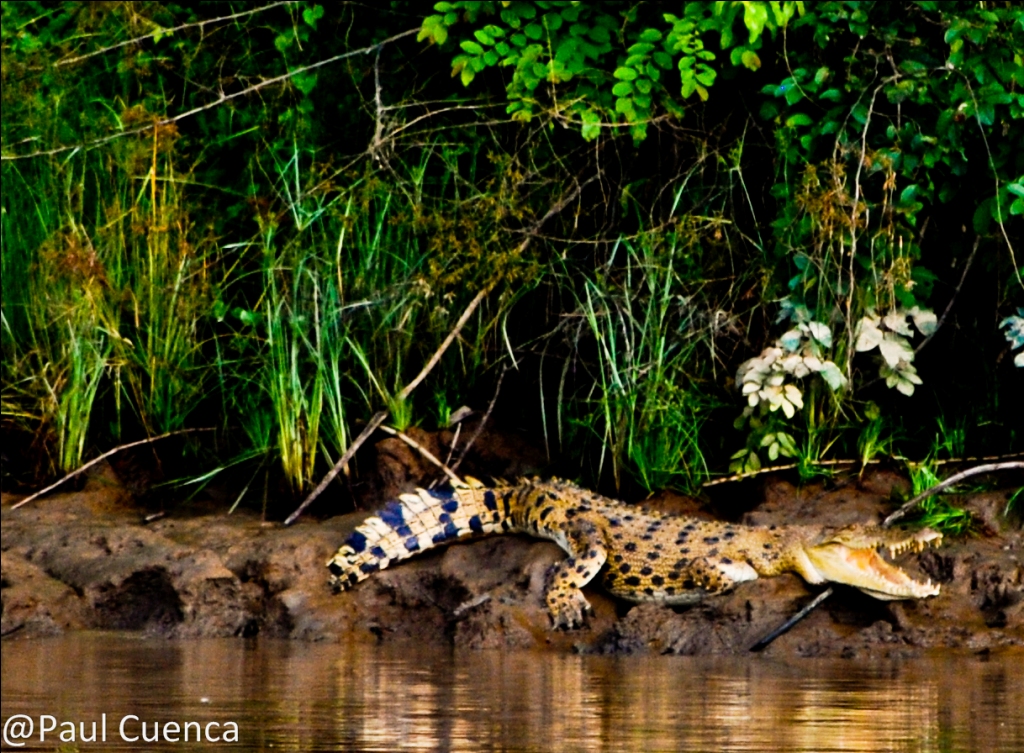
The boat slows down and our guide quietly motions to an area near the mud bank. Coming to a crawl, our boatman manoeuvres carefully to what looks like a log with black holes on its side. As quickly as we see it, it disappears under the water with barely a wake. A quick tug at my shirt and I’m directed to look at the other side of the river. Deja vu!  I’ve seen this before in an episode of NatGeo Adventure about the Zambezi River in Africa. This log has an open mouth with an impressive row of teeth; it’s an estuarine crocodile or a copper croc as one local calls it, basking in the morning sun. Ten feet of solidity with luminescent eyes gazing at our boat, the croc is staying long enough for me to get a decent shot with my camera. Boy, I hope my settings are all correct as I rattle off multiple shots in quick succession hoping to get the Money shot. The croc heard my camera clicking and slides into the water. We move on down the river and we see a clearing in the forest and 2 figures appear on top of a dead tree -- a mating pair of Pied Hornbills squawking and bobbing to their hearts content.  Eight kinds of hornbills inhabit this area and I catch glimpses of them flying in tandem across the river with their signature squawk. Right next to them are another pair of Storm Stork, which our guide tells me is one of the top 5 rare birds in this area. The large birds with a balding head and spindly legs remind me of 2 old-timers hanging out in a bar having a beer.
Onto another break in the forest and I hear a “whoosh” whistle by the boat. We know it’s something big that flew past us but it was too fast and headed towards the thick canopy. Patiently, we wait and stand our ground but I have this eerie feeling that something is watching our every move.  Our patience is rewarded; a White Bellied Fish Eagle sits majestically on a large Fig Tree surveying its kingdom.  Not once did it look at us, but the eagle gave us a profile showing off his regal beak as if to say this is my photogenic side. This eagle gave me the privilege to be in his royal presence.  I willingly oblige and take several shots of His Airness; I feel like a bird paparazzi making sure I had the TMZ shot.  Heard but not seen were the bearded pig, babblers, barbets, mynas and the rhino hornbill.  We have just passed the first hour of our boat ride; this is already wildlife overload. Here we are, with 2 more days to go and we haven’t seen the monkeys, large primates and elephants just yet.
Where is this wildlife reserve, you might wonder? It is not in the deep jungles of the Congo, or out in the mighty Amazon River. It’s not even somewhere closer like the Brahmaputra in India or even the Mekong River in Indo-China.  We are in Sabah, Malaysia, this “Land below the Wind” where typhoons never tread. A mere 2 hours by plane from Manila, with no visa required, will get you to the mighty Kinabatagan River. Located in the eastern section of Sabah in the Sandakan District, the longest river in Sabah winds and snakes its way for 560 kms starting from the eastern Witti Mountain Range and flows into the Sulu Sea.  Kinabatagan River means Chinese River in Malay denoting the early Chinese traders who went up this river in the 13th century to trade with the Orang Sungei (River people) for birds nest, rhino horns, elephant ivory and exotic lumber. Today, tourists are attracted to the riches of diverse landscapes along the river from limestone caves, dipterocarp forests, riverine forests, freshwater swamps, oxbow lakes and mangrove swamps. The World Wildlife Fund (WWF) states that this area is one of only two known places on Earth where 10 primate species can be found. Some of these include the Orang Utan, the Proboscis Monkey, Macaques, Maroon langur and Bornean gibbon, most of which are endemic to Borneo. Bird lovers will find the bird watching incredible: all 8 of Borneo's hornbill species are seen regularly. Of the 200 other species of birds recorded in the area, eight of these are of Malaysia's threatened bird species. The large mammals like the Borneo Pygmy Elephant, Sumatran Rhino, Malaysian Sun Bear, Barking Deer and Clouded Leopard are on the must see list but are harder to find.  My Lonely Planet and Rough Guides Adventure Books rate the wildlife viewing in the Kinabatagan as a “Must See” destination in the world of adventure travel.  Just look at these numbers: 15,000 species of flowering plants, 3000 species of trees, 220 land mammals, 200 species of birds and 10 primates all found in this rich ecosystem of biodiversity.  The wildlife in the Kinabatagan is acknowledged by experts to be the most varied and easily accessible in Southeast Asia

I’m surprised at how smooth the water is on the river. It’s so flat, I could have tried barefoot skiing with no problem at all. It’s late in the afternoon and we venture upriver deeper into the jungle. Tipped by his fellow-guide, our guide Patrick wanted to check an area where he had seen a family of 50 Borneo Pygmy Elephants that feed and drink together up and down the river before. The herd was not seen here for at least a month since the heavy rains swelled the banks of the river. Nearly an hour later, the light is quickly fading and we have yet to find the herd.  Then, we see another boat parked by the side of the river and curiously, we approach it. There he is, one young adult male quietly feeding on the long grass minding his business. We inch up to at least 20 feet, feeling the excitement and the rush of being so close to a wild elephant.  His trunk flicking the grass, ears flapping and tail wagging in unison got me feverishly clicking my camera and video cam all at once. We move on and we see a apair almost submerged with their trunks acting like a snorkel.  Peeking into a small tributary, we see another group of four and then we hear more commotion within the forest canopy. The distinctive trumpeting sound resonates up the river. We’ve hit the mother lode, an elephant picnic!  Female, male, big, small, with tusks or none, all shapes and sizes are represented. Behind all the feeding adults, we notice a small baby hanging on to the every move of Mom’s tail.  They seem to all be so preoccupied in eating and drinking that nothing seems to bother them. It is estimated that an average adult elephant can eat up to 300 pounds of vegetation and forage up to 20 hours per day to support their bulk and appetite. I am surprised at how docile they are, with human-like sensitivity. I witness a pair helping each other climb the riverbank with their trunks and thanking each other with a soft pat on their heads. You can’t see this kind of natural interaction in any zoo. We feel so blessed to see free elephants displaying their true nature.
My animal bucket list for the Kinabatagan is almost complete and I’m just missing the stars of the show, the Orangutan & Proboscis Monkey. It’s starting to get dark and this is the best time to look for the monkeys as they go near the river to sleep in the trees for protection.   Finally, we come across 3 fur balls in one tree with their backsides to us, and long white tails hanging. It’s our first glimpse of the famed monkey and the next tree finally reveals a large male. Boy, their noble nose is big & plump and with a potbelly to match, I stopped wondering why they’re called Orang Belanda or Dutchman. This proboscis monkey could have come from a Dutch bar and you couldn’t tell the difference.  We are graced with their typical signature “yelp” sound and their penchant for making long jumps. Patrick excitedly tells us to look up further to the top of the biggest tree and check the shadowy figures.  He claims that it’s a Silver Leaf Langur and even more rare Albino Langur next to each other. I can hardly see them but I catch the distinct silhouette of a monkeys’ Mohawk hair and beard surrounding its face.  That was a good bonus for us but we still needed to see a wild orang-utan. We check a promising area that indicates recent orang-utan activity. Unfortunately, that is as close as we got to seeing one, since we had to turn back because of fading light. The end of the day was punctuated by a cloud bank shaped like an elephants head against the dusk sky. What a way to finish this glorious journey!
A larger question now has to be answered.  Why should we even care or go to the Kinabatagan River? One can say that we can just go to the zoo and see the same animals without all the hassles. That answer captures the spirit of modern urban life, where we are conditioned for convenience. The disconnect we have to nature, where we worry more about the hassle of getting there. For me, the Kinabatagan represents a bygone era of exploration when the Congo, the Amazon and the Nile were rivers of mystery and intrepid adventurers like David Livingstone & Richard Burton discovered them.  It is a rare opportunity to visit and experience what the jungles of Asia were like a hundred years ago. There is nothing like the high of getting close to a wild animal and marvel at its majesty and simplicity. Something magical happens, and you feel like a boy in a candy shop with too many sweets to choose from. 
Storm clouds are gathering on the horizon, habitat loss due to heavy logging and encroachment of palm oil plantations are the gravest threat to this region and its animals. It would be a tragedy if we allow a treasure like the Kinabatagan to be lost. The best and probably the only way to preserve this unique area is to view it as tourists and be witnesses to its glory and leave a lasting legacy for our children. On the morning we left our resort, a wild boar visited us and went straight to a palm oil plantation eating loads of palm oil fruit. This is poetic justice and a fitting end to our adventure.  Signing off till the next adventure...will check in from the crystal clear waters of Papua New Guinea. 
Here is our take on the best climbs & treks of the mountains in the Philippines. This is by no means a definitive list and should only be regarded as a rough guide. We submitted this article to Lonely Planet Philippines.


Sentimental Favorite : Mt. Anacuao
Location:  Dinalugan, Aurora Province
Why Go:  This Mountain is challenging to climb with a Level 3 rating and is part of the fabled Sierra Madre range.  It is relatively easy to get to from Manila as compared to other mountains in the Sierra Madres. Its summit is unique in that you need to go through a cave to reach the peak at 1,600 meters. The base camp is situated in a clearing that offers unfettered views of Casiguran Sound & San Ildefonso Peninsula. It has pristine forests, numerous birdlife like Rufous Hornbills and crystal clear running water that’s safe to drink. It is remote and there are few people that climb this mountain. My first Level 3 climb and its pristine state make Anacuao a sentimental favourite for me.
Best Time: The best time to climb is during the summer period.
How to Get There:  From Manila, you can take a Genesis Bus direct to Baler, Aurora. From Aurora, you can take a local bus that plies the route to Dinalugan Town. Get dropped off at the town hall where you can arrange for the climb with the local authorities.

Best Kept Secret:  Mt. Guiting Guiting
Location:  Sibuyan Island, Romblon Province
Why Go: One of the top 3 hardest climbs in the Philippines along with Mt. Halcon & Mt. Mantalingajan. G2 as it is fondly called, has a jagged knife edge ridge and rock formations that you will have to negotiate to get to the summit at 2,058 meters. Hard core climbers are attracted to this mountain because of its technical climb and the breathtaking views of the Sibuyan Sea and even Mt. Mayon on a clear day. The island of Sibuyan itself has beautiful beaches, waterfalls, clean rivers and endemic flora and fauna.
Best Time: The best time to climb is during the summer period.
How to Get There:  From Manila, you need to get to Batangas Pier and take a Montenegro Lines that offers daily trips to Romblon. You will need to take a local boat to Magdiwang Port in the island of Sibuyan. Take a tricycle or jeep to the DENR ranger station to register for your climb.
Most Hard Core:  Mt. Mantalingajan
Location:  Rizal, Southern Palawan
Why Go: Considered probably the most difficult climb in the Philippines, it will take at least 5 days to climb this peak. The trails are steep, narrow and nonexistent, climb over boulders, walk on the canopy of dwarf trees and crawl on sharp rocks to get to the summit at 2,086 meters. The ever present danger of malaria carrying mosquitoes and leeches await only the toughest of climbers to assault this forbidding mountain. Despite its hard core nature, there are fascinating interactions with the local Tau’t Bato (People of the Stone) and is considered as a biodiversity hotspot for endemic Palawan Birds. This area has been recently gazetted as a protected national park
Best Time: The best time to climb is during the summer period. Rainy season is a definite no go on this mountain.
How to Get There:  From Manila, take a plane or boat to Puerto Princesa. From there, take a bus to Rizal town that will take about 6 hours. From Rizal, take a jeep to Barangay Ransang which is the jump off point for the climb.

Best for Beginners:  Mt. Maculot
Location:  Cuenca, Batangas
Why Go:  Maculot is a popular dayhike destination for all kinds of climbers due to its accessibility and its easy trail. This mountain is so popular during the summer months that a sari sari store is set up at the campsite to offer food & drinks to hikers. There is a good balance of easy trail and also some challenging parts when you reach the rockies summit at 830 meters. The payoff here is the beautiful view of the entire Taal Lake from one side and the Mountains of Makiling and even Mt. Halcon in Mindoro on a clear day from the other side.
Best Time: The best time to climb is during the summer period.
How to Get There:  From Manila, take a bus to Lipa City, Batangas. From Lipa, you take a jeep to Poblacion town then take a tricycle to the barangay outpost where you register for your climb.


Most Romantic:  Mt. Pulag
Location:  Ambageg, Benguet Province
Why Go:  Mt. Pulag is the highest point in Luzon Island at 2,922 meters and is considered one of the most beautiful mountains in the country. Fabled views of the “sea of clouds”, tall neighbouring peaks and dwarf bamboo forest has been given the name of “playground of the gods” by the native tribes. The Ambageg trail starts at a high elevation and is quite easy to get to the summit. The coldness of the weather amid the beautiful pine trees and montane forests while encountering the local hill tribes along the way is a great treat for most climbers. Couples wanting to have a different shared experience should go to Pulag.
Best Time: The best time to climb is during the summer period. January to March is fine but very chilly and can go as low as freezing.
How to Get There:  From Manila, take a Victory Liner to Baguio City. From there, take a jeepney to Ambageg and be brought to the Ranger Station where you will register for your climb.

Most Scenic:  Mt. Pinatubo
Location:  Capas, Tarlac
Why Go:  The volcanic eruption felt around the world, the infamous Mt. Pinatubo has become a premier destination for trekkers in the Philippines. The landscape in the crater can be described as “moon like” and “out of this world” because of the barren and desolate surroundings in the aftermath of the eruption. Take a 4x4 jeep along endless volcanic sand and lahar towers, then trek along mineral covered rocks with varying colours and finally reaching the crater to take a swim in its reddish sulphuric waters. The very different landscape compared to most mountains in the Philippines makes Pinatubo the most scenic.
Best Time: Fine most of the year except for the rainy season as there might be flash floods.
How to Get There:  From Manila, take the NLEX to the very end and exit Mabalacat, Pampanga. Go to Macarthur Highway to Capas, Tarlac and drop off at Barangay Sta. Juliana.

Year Round Favorite:  Mt. Cristobal
Location:  San Pablo, Laguna
Why Go:  Cristobal is the sister peak of Mt. Banahaw and is sometimes referred to as the Devil Mountain because of local spirits that supposedly haunts the trail. The mystique of the spirits, the straightforward and clean trails, pristine forests, a splendid array of flora and fauna and a crater at the top makes Critobal as favourite climb for mountaineers. It is tall enough at 1,470 meters that it can be climbed as a full day hike or an overnite camping trip. Its proximity to Manila and its reputation as a real mountain trek makes Cristobal a year round favourite for climbers.
Best Time: Fine most of the year except for the rainy season as there might be flash floods.
How to Get There:  From Manila, take a bus to San Pablo City via Lucena or JAM lines. At San Pablo, you can rent a jeepney to Barangay Kinabuhayan where you can get guides to take you to the mountain.

Friday, May 14, 2010

River MONSTERS


There are 2 new documentaries being shown in NatGeo and Discovery Channel about gigantic river fish that inhabit the rivers of the world. When you say large fish this is normally associated with Saltwater monsters like Marlin, Tuna and Shark. These documentaries claim that in large rivers lurk monster size fish that are capable man-eaters. Dr Jeremy Wade who hosts River Monsters, investigates cases worldwide of people being eaten by monster river fish. From the Alligator Gar in Texas, the Goonch in India, Mekong Giant Catfish and even Bull Sharks upriver, it is amazing to see fish this size inhabiting local rivers. Dr. Zeb Hogan of National Geographic goes around the world to survey and study these little known river giants."Many of the places I hope to explore have been virtually untouched by scientific study," Hogan notes. "It's a real chance to make discoveries about local biodiversity, compare the ecology of different river systems, provide new observations on animal behavior, and perhaps even discover new species."The world's biggest freshwater fish, many of which weigh more than 200 pounds (90 kilograms), face the biggest threats. That's why Hogan is undertaking a global survey of giant freshwater fish.

Thursday, May 13, 2010

Raja Ampat - The Four Kings


The realm of the Four Kings remains untouched in a small corner of Papua New Guinea. Those who visit the kingdom of the Four Kings are mesmerized by its beauty and majesty. This group of islands near the northwestern tip of Papua New Guinea's Bird's Head Seascape lies in the heart of the famed Coral Triangle, which has been proclaimed by scientists as the most bio-diverse on the earth.

According to the Conservation International Rapid Assessment Bulletin, the marine life diversity for scuba diving in Irian Jaya is considerably greater than all other areas sampled in the coral triangle of Indonesia, Philippines and Papua New Guinea – the cream of the cream in world diving. Over 1,200 fish species – a world record 284 on one single dive at Kofiau Island, the benchmark figure for an excellent dive site of 200 fish species surpassed on 51% of Raja Ampat dives (another world record), 600 coral species , 699 mollusc species – again another world high. The term “Frontier Diving” seems to have been invented for Raja Ampat in Irian Jaya. The best way to traverse this beautiful area is by Diving Liveaboards where you can stay from 7 days up to 2 weeks for transition trips.

Thursday, February 25, 2010

Yamaha Super Tenere


"Adventure travelling takes skill, courage and endurance – as well as faith in your machine. Faith that it’ll love rocky river crossings and dirt roads as much as you do. Faith that it’s going to be comfortable on a long freeway haul. Faith that it’s got what it takes to carve up twisty mountain roads. The all-new Yamaha Super Ténéré is built from the ground up to be the most exciting next-generation adventure tourer, combining Yamaha’s Dakar-bred toughness and reliability with light, easy handling and advanced rider assist technology.We kept the mass low and central for light, agile handling from walking pace on a rocky trail to attack velocity in the twisties. We built it tough, with spoked rims and inbuilt engine protection for offroad adventures. We made it comfortable and practical for long-haul touring. And we loaded it with the latest in rider assist technology for exceptional safety and confidence. Press release from Yamaha Motors about their brand new Super Tenere Adventure Bike. 1200cc engine power at your fingertips when you negotiate all kinds of terrain with all the gear needed to go on for days.

Thursday, October 15, 2009

Swooping - Skydiving on Steroids


Swooping or Canopy piloting as it's technically called involves a new form of skydiving. The canopy pilot deploying their canopy at 5000 ft, piloting their canopy to an "execution" point over the swoop course, then turning into a rotating dive dramatically increasing the canopy's speed. The canopy pilot stops the canopy's rotation on the proper course heading, while at the correct altitude allowing their canopy to recover from the dive and level out with maximum speed before entering the course, Maximum speeds regularly reaching in excess of 90 mph. Essentially, swooping is using a much smaller parachute to increase the speed of the descent so that you can skim at speeds of 90 mph over a prepared course on water.

This new skydiving discipline now has a Pro Swooping Tour for hardcore enthusiasts to test their swooping skills against other competitors. I saw this on TV the other day and saw them swoop over tree canopies, glaciers and rocky terrain at high speed. I am sure that swooping will be in the Philippines very soon and I can suggest a swooping course for them - CAMSUR. You heard it here first.

Monday, October 5, 2009

Skeleton Coast - Air Safari's


Conjure up visions of mist shrouded windswept beaches bordered by wild seas strewn with bleached whalebones and rusted shipwrecks, rolling sand dunes, vast desert plains, fossil beds and unique rock formations. Now imagine traversing this wild and haunting landscape by plane and you have Skeleton Coast Safari's in Namibia.

Operated by the pioneering Schoemann Family, they have set out to redefine African safari's by using a plane as a safari vehicle and exploring the forbidding coastline of the skeleton coast. Highlights of the trip include desert coastlines with roaring dunes ; ancient rock drawings ; living fossil trees ; ugab rock formations ; red lava and yellow sandstone environs ; nomadic Himba tribes and panoramic vistas of the Hartmann Valley. Because of the unique landscape and remoteness of the area, these trips are a photographers paradise and it is recommended that you bring extra photo equipment. Accommodations are comfortable & well equipped in exclusive fully tented camps and are located in spots selected for their unique beauty.

Friday, October 2, 2009

Queenstown, NZ - ADVENTURE TOWN

Queenstown in New Zealand's South Island can lay claim as one of the top adventure destinations in the world. It is blessed with glacial rivers and lakes set against the backdrop of the Remarkables Mountain Range. It has been argued that adventure tourism started in Queenstown in the early 70's. A farmer named Bill Hamilton invented a jet powered boat that can maneuver in just a few inches of water. The Shotover Jetboat ride was born and all kinds of daredevil activities like bungee jumping , base jumping and whitewater rafting followed.

30 years on and Queenstown is firmly established on the must go list of all adventure seekers worldwide. Take to the skies over Lake Wakatipu by helicopter, hang-glider and parachute; descend river canyons by raft, kayak and jetboat; experience bungy jump off the 440 foot Nevis Highwire; abseil into gorges and swing across them on the 360 foot Shotover Canyon Swing. The list goes on with 4 WD safari, canyoning, rock climbing, heli- skiing, tramping, fly fishing, horseback riding and fly in an aerobatic plane. It is also a wine growing region and has been used as locations for the Lord of the Rings Trilogy and XMen films. This place is at the top of my TO DO list.

Saturday, September 26, 2009

ICON - Flying Jetski


Got this from NatGeo Blog. The ICON A5 Amphibious Sport Aircraft is everyman's dream of owning a plane and taking off for a weekend flight. The aircraft is 22 Ft Long, carbon hulled, barrels in at 120mph, folding wings and takes 20 gallons of unleaded gasoline. With it's folding wings, you can tow it behind your car and go to the lake and launch it like a jetski. The canopy inside looks just like a car dashboard with twin joysticks for control. The ICON costs U$ 139,000 (cheaper than a Ferrari) and will be rolling out of the ICON Aircraft factory by 2011.

So how does one get to fly this amazing aircraft? The ICON is part of a new category called Light Sport Aircraft where you can get a special license for Sport Pilots from the FAA in the US. Flight Training is a minimum of 20 hours costing U$ 3,500 which allows you to fly at 10,000 feet and go cross country. Restrictions are no flying at night and no flying in bad weather. Why would you want to fly into a thunderstorm in a 22 foot flying jetski anyway? Checkout out the incredible flight video of the ICON.

Friday, September 18, 2009

BIG GAME Fishing - Spratly Islands


The Spratly's, a group of 650 reefs, atolls and islands in the middle of South China Sea, has been a flashpoint of gunboat diplomacy and demarcation of international boundaries since 1933. China, Vietnam, Taiwan, Philippines and Malaysia all have competing claims and have established military bases in this area. The map on the right shows the Spratly region with the disputed area's among the 5 countries. So whats all the fuss about these rocks in the middle of the sea? Besides being in the middle of the busiest shipping lanes and an estimated 17 billion tons of oil reserves, the Spratly's is blessed with one of the world's most productive fishing areas.

Imagine fishing in the middle of uninhabited coral atolls plunging to depths of 2,500 meters hunting for big game fish. Trophy fish like Black Marlin, Sailfish, Yellowfin Tuna, Giant Trevally, Giant Grouper and Hammerhead Sharks are on the list of targeted species. Specialty bottom fishing at night to depths of 250 meters can net the elusive blunt nose six gill shark, baracouta and escolar. Since 2003, IGFA sponsored Labuan Intl GameFishing Tournament has been held in the Spratly's. I was fortunate enough to fish the malaysian spratly's in the 90's and it's truly a mecca for big game fishing enthusiasts. There are now fishing safari charters on modern fishing yacht's for 5 days of fishing to Malaysian held Swallow & Ardasier Reefs. Charters are available for the 2010 season. Send an email to: adventure@intrepid.ph

Thursday, September 17, 2009

INTREPID Adventurer - Reinhold Messner


Reinhold Messner, the maverick rock climber, green politician, high altitude alpinist, Yeti Hunter and controversial rule breaker. The superlatives are endless in trying to describe arguably the greatest mountain climber of all time.

Messner pioneered the solo ascent without supplemental oxygen to the highest peaks of Mt. Everest & Nanga Parbat and broke all conventional wisdom for high altitude climbing. Messner set the agenda for modern mountaineering. He stripped the sport to its basic form. He tossed away the concept of oxygen tanks and big teams and camps, and made mountaineering a more equal contest between man and mountain. He wrote about what it was like to live and die where the air is so thin that every breath is a triumph. He became the first real solo rock star climber. When he climbed Lhotse in 1986, he became the first man to climb all 14 mountains above 8,000 meters. Messner said, 'We were real mountaineers: careful, aware and even afraid. By climbing mountains we were not learning how big we were. We were finding out how breakable, how weak and how full of fear we are. You can only get this if you expose yourself to high danger. I have always said that a mountain without danger is not a mountain.' Reinhold Messner - INTREPID ADVENTURER

Tuesday, September 15, 2009

Paradise Found by Motorbike


I’ve been fortunate enough to ride some incredible roads – roads in the Alps, in Australia, in America, in South Africa – but none of them – NONE – have combined riding challenge, surface quality, location, weather and a lack of traffic to quite the same effect as this. - BIKE UK Magazine 2007


"More then 200 turns of every kind of camber and radius imaginable, one following the other with no straightaways in between. Dragging pegs through hairpins, throwing my weight across the bike while rolling the power on through the curve. I’ll be dreaming of that road for years to come and I don’t have enough expletives to properly describe it to you.“This next section is 60km of insanity,” he quips before sending me off. I tear off down this unimaginably empty road where I hit 170km, then brake into huge sweeping corners at 140km, slowing into 90km inclined hairpins and I just kept trying to ramp more speed into each corner" - Mike S. from Canada


Imagine traversing the wild landscape of Borneo on 650 Trail Bikes. 300 kilometers of intense riding on daily jaunts to the many scenic backdrops of Borneo. Ride along beaches, streams, gravel trails and numerous winding tarmacs. Cross the Crocker Mountain Range 5,000 feet above sea level and witness the spectacular views of Mt. TrusMadi. Wind your way through waterfalls, paddy fields, village trails and have lunch in quaint coffee shops. Explore mangrove swamps and negotiate sections called “Slalom 1 & 2 , Formula 1 & The Bomb Hole.” End your days with a swim, cocktails over sunset and prepare for barbeque dinner on the patio overlooking the lights of town. Riding Paradise has been found! If your interested in Motorbiking in Borneo, send an email to: adventure@intrepid.ph

Via Ferrata - Rock Climbing for Everyone


Via Ferrata, ( iron ladder in italian) is a mountain route which is equipped with fixed cables, steps, ladders and bridges. These via ferrata's were first used in Italy during WW1 to assist the movement of mountain infantry. Walkers and novice climbers can follow via ferrata's to isolated mountain routes with very little climbing experience and the danger associated with unassisted climbing is diminished. Alpine Walking Holidays for via ferrata are very popular during Summer season in European countries like Italy, Germany, France & Switzerland.

I have personally experienced the first Asian via ferrata in Malaysia. It is an incredible thrill to be able to climb the vertical rockface of a mountain as the spectacular views are unmatched by any regular mountain trail. The fear of hanging on the cliff edge at 10,000 feet above the clouds is quickly tempered by the secure feeling of the iron cable fixtures and steps. You rapidly come to grips with walking the iron steps and you find yourself moving across the vertical rockface like any other mountain trail. This is as close as your going to get to climbing El Capitan. If your interested in via ferrata, send an email to: adventure@intrepid.ph

Monday, September 14, 2009

Red Demons of Mexico


The Giant Squids of Baja or commonly known as the Humboldt Squid can now be seen up close via a unique tether diving system. The Red Demon Squid, an apex predator, can reach the size of 7 Feet and weigh over 150 pounds and has a very bad reputation among local fishermen. Travelers craving encounters with the world's weirdest wildlife need not look further than the red demon squid and is the newest thrill for seekers of high-adrenalin diving adventures.The animal has three hearts, blue blood, eight arms, two tentacles and 70,000 teeth," says Scott Cassell, team leader for Sea Wolves. "Even though you are wearing chain mail armor, its beak can snap a hand, arm or foot off if you're not careful. Diving with the giant squid is not for novices."

The recent videos in Discovery & History Channels on the red demon squid was probably the inspiration for the legendary Kraken and the Giant Squid (Archituthis). The thrill of diving with this living monster will be an experience of a lifetime.

The Supreme Test - Namibia Ultra Marathon

The third edition of the Namibia 24 Hour Ultra Marathon is slated for May 24, 2010. Known as the ultimate endurance test for distance runners, the marathon will cover 126 kilometers within a 24 hour period. Water stations and medical tents are located every 21 kms. Runners will have to be self-sufficient throughout, carrying all their food, water, energy bars and change of clothing on their backs. The setting is the forbidding Namib Desert where temperatures will range from 36 degrees to 5 degrees at night. Competitors will travel along the dusty gravel plains, dry riverbeds and vast sand expanses of the oldest desert in the world, before passing through the spectacular Messum Crater and finishing at one of the most hostile coastlines on earth, the Skeleton Coast.

From the race accounts, I can only imagine the suffering that the runners will endure in such a harsh climate like the Namib Desert. Most of the runners are accomplished marathoners who have trained as best as they could to simulate the unrelenting conditions of the desert. They talk about getting goose bumps, raging thirst and hallucinations and all the symptoms of heatstroke. Some runners are beaten to a pulp and look haunted, but somehow they soldier on carried by their will to finish. This grand adventure, the camaraderie among like minded souls and the participation in the most supreme challenge is what sets this race apart.

Killer CROC of Burundi


The legendary Gustave, the killer crocodile of Burundi strikes again. The infamous maneater was reportedly spotted by Patrice Faye, a naturalist who has been tracking the croc since 1998. Gustave is 20 feet long and weighs in at 2,000 pounds and is reputed to have devoured hundreds of villagers in the shores of Lake Tanganyika.

I saw the episode from NatGeo that was dedicated to capturing Gustave a couple of years ago. A full expedition, complete with high tech equipment and a purpose built trap, tried for weeks to capture the croc but to no avail. A crocodile this big and this old is just too smart to fall victim to a steel trap. NatGeo's story on Gustave recieved the highest number of hits in the history of it's website. This story just shows how our society needs it's monsters to survive. Let's hope that NatGeo considers another expedition to track and capture Gustave. We need our Monsters whether real or imagined (Bigfoot, Yeti).

Mt. Kinabalu Climbathon


The 23rd edition of the Mt. Kinabalu Climbathon will be held on Oct. 24-25, 2009 in Sabah, Malaysia. The climbing marathon will be held in SE Asia's highest mountain at 14,000 feet and Malaysia's first world heritage site. Arguably the world's toughest mountain race, this event is held in conjuction with Sabah Parks and the International Skyrunning Federation and is part of the 7 race skyrunning world series.

I climbed this mountain and I thought I was fairly fit and it still took me 9 hours to climb the 8.7 kilometer trail to the summit and another 4 hours just to get down to the starting point. What slows you down is how you deal with physical & mental fatigue and altitude sickness. The hardest part is the descent because you have to deal with tired legs and mental fatigue and it is very easy to slip on the rocks and injure yourself. The winner of the race last year clocked in at 2hrs and 45 minutes. What else can you say? Leave it to the professionals :)


The Lost World of New Guinea


The Natural History Unit of BBC just came back from their expedition in the heart of Papua New Guinea. The team of scientists found a Lost World of new animal species on an extinct kilometer deep volcano crater of Mt. Bosavi. The prisitine jungles within the crater allowed many animals to develop in isolation for the last 200,000 years since the volcano last erupted.

Among the 40 new unidentified species of animals, the most bizzare was a giant woolly rat the size of a house cat and a kangaroo that evolved to live in trees. The isolation of the site has conditioned the animals not to be afraid of humans. It is astounding to think that there are patches of nature that still remain untouched and undiscovered. The challenge now is to protect and save these natural edens from habitat loss because of logging.